
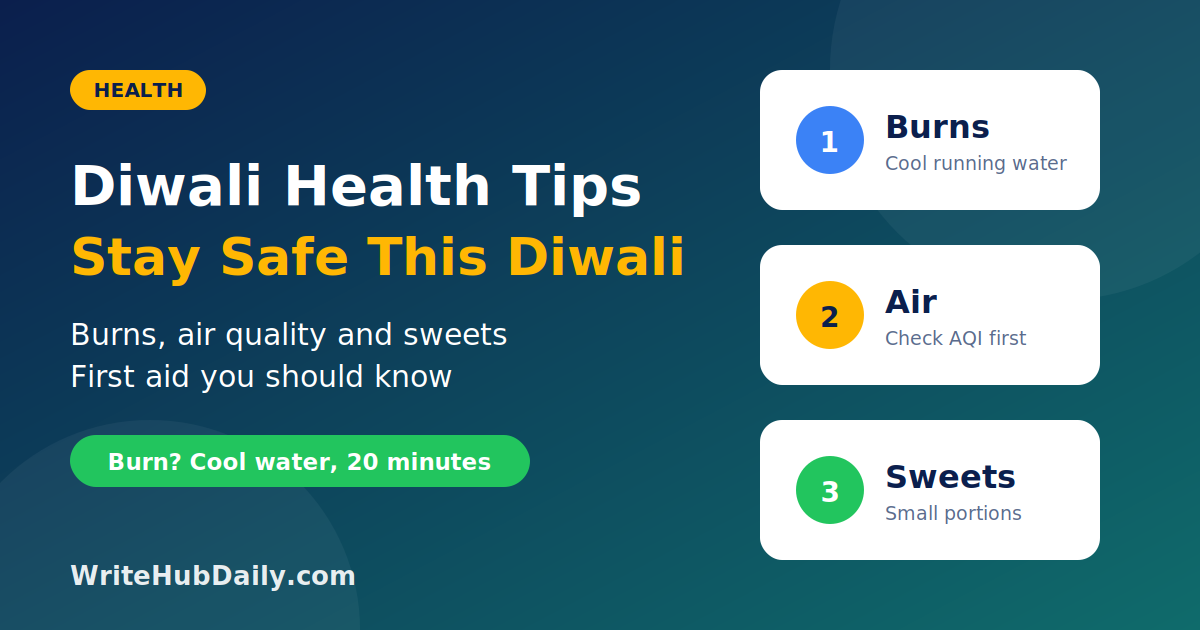
Diwali health tips are most useful before the festival starts. Between firecrackers, smoky air, rich sweets and late nights, Diwali week sends many people to hospital with burns, breathing trouble or sugar spikes. This guide covers the basics: firecracker safety, burn first aid, protecting your lungs and eating sensibly.
This article is general information, not a substitute for medical advice. In an emergency, call 112 or your local ambulance number and go to the nearest hospital.
Diwali Health Tips: Quick Summary
| Risk | What to do |
|---|---|
| Burns | Cool the burn with cool running water for about 20 minutes, then get medical help for anything serious |
| Eye injury | Do not rub the eye. Cover it lightly and go to a hospital immediately |
| Smoke and pollution | Check the AQI, limit outdoor time, and keep medicines ready if you have asthma |
| Sweets and sugar | Eat small portions and keep regular meals, especially if you have diabetes |
Firecracker Safety Rules
- Follow local rules. Some cities restrict or ban certain firecrackers, or limit the times for using them.
- Adults must supervise children at all times, and children should never light fireworks alone.
- Use an open space away from buildings, vehicles, dry leaves and crowds.
- Keep a bucket of water or a sand bucket nearby.
- Light one at a time, at arm's length, and step back quickly. Never hold a firecracker in your hand.
- Do not relight duds. Pour water over them and wait before touching.
- Wear cotton clothes, not loose synthetic fabrics, and avoid long dupattas and dangling clothes near flames.
- Keep pets indoors in a quiet room, because noise can frighten and harm them.
Burn First Aid: What to Do
- Move away from the source and remove burning or smouldering clothing, unless it is stuck to the skin.
- Cool the burn under cool running water for about 20 minutes. Do not use ice or very cold water.
- Take off rings, watches or tight items near the burn before it swells.
- Cover the burn loosely with a clean, non-fluffy cloth or cling film.
- Do not apply toothpaste, butter, ointments or home remedies, and do not burst blisters.
- Get medical help quickly for burns on the face, eyes, hands, feet or genitals, burns that are large or deep, and any burn in a child or older adult.
Eye Injuries
Firecracker injuries to the eye can cause permanent damage. If a spark or particle hits an eye, do not rub it and do not press on it. Cover it lightly with a clean shield or cup and go to a hospital or an eye specialist immediately, even if the pain seems small.
Protect Your Lungs From Smoke and Pollution
- Check the air quality index (AQI) in your city before you go out, using an official or reliable air quality app.
- Limit outdoor exercise and walks on smoky evenings, especially for children, older adults and people with asthma, COPD or heart disease.
- Use a well-fitted N95 or similar mask if you must be outside during heavy smoke. Ordinary cloth masks give little protection against fine particles.
- Keep inhalers and regular medicines handy, and follow your doctor's asthma plan. Call your doctor if breathing worsens.
- Keep windows closed during peak smoke hours and use an air purifier with a HEPA filter if you have one.
Enjoy Sweets Without a Sugar Spike
- Eat regular meals, and do not skip meals to "save space" for sweets.
- Choose smaller portions, and have sweets after a meal instead of on an empty stomach.
- Drink water and limit sugary drinks.
- If you have diabetes, follow your doctor's advice on medicines and monitoring, and ask whether you should check your blood sugar more often during the festival.
- Be careful with food from unknown sources. Choose fresh sweets from clean shops, and store leftovers in the fridge.
Sleep and Stress
Late nights, travel and family gatherings can disturb your sleep and routine. Try to keep a fairly regular sleep time, and see our guide on how to improve your sleep routine. If the festival season feels stressful or lonely, talk to someone you trust. The Tele-MANAS helpline, 14416, is free and open 24 hours. Read more in our Tele-MANAS guide.
Frequently Asked Questions
What is the first aid for a firecracker burn?
Cool the burn with cool running water for about 20 minutes, remove tight items, and cover it loosely with a clean cloth. Do not use ice, toothpaste or butter. Seek medical help for serious burns.
Do masks protect against firecracker smoke?
A well-fitted N95 or similar mask gives better protection against fine particles than a simple cloth mask. Limiting your exposure is still the best approach.
Can people with diabetes eat Diwali sweets?
Many can eat small portions as part of a planned meal, but this depends on your health and treatment. Ask your doctor for advice that fits you.
Conclusion
The best Diwali health tips are simple: use firecrackers carefully and with supervision, know the first aid for burns, protect your lungs on smoky days and keep sweets in moderation. A little preparation helps everyone enjoy the festival safely.
Disclaimer: This article is for general information and does not replace professional medical advice. If you or someone else is injured or unwell, seek medical care immediately.